
How to Learn Kanji with Radicals and Visual Mnemonics: The Definitive Guide
Writing a character 50 times on grid paper is the slowest way to learn Japanese. Here is the cognitive science behind Visual Mnemonics, Radical Families, and how one unified illustration locks kanji into permanent memory.
Ask ten Japanese learners what part of the language nearly made them quit, and nine will give the exact same answer: Kanji. Not because Japanese grammar is impossible, and not because pronunciation is hard — but because traditional kanji study asks your brain to do something it evolved to hate: memorize thousands of abstract black lines through brute repetition.
1. Why Rote Writing ("Write It 50 Times") Fails Your Brain
For decades, textbooks and classroom teachers taught kanji the same way: open a squared grid notebook, copy a character fifty times from left to right, and hope it sticks by Friday's quiz. Cognitive psychologists call this maintenance rehearsal, and research consistently shows it produces the weakest long-term retention of any study method.
Your visual cortex did not evolve to store arbitrary geometric grids. It evolved to remember places, characters, emotions, and spatial stories. This phenomenon is known in cognitive science as the Picture Superiority Effect: when information is encoded as a vivid illustration tied to a story, recall rates after 72 hours jump from roughly 10% (text/rote symbols) to over 65–85%.
2. The Two-Step Revolution: Radicals + Unified Visual Stories
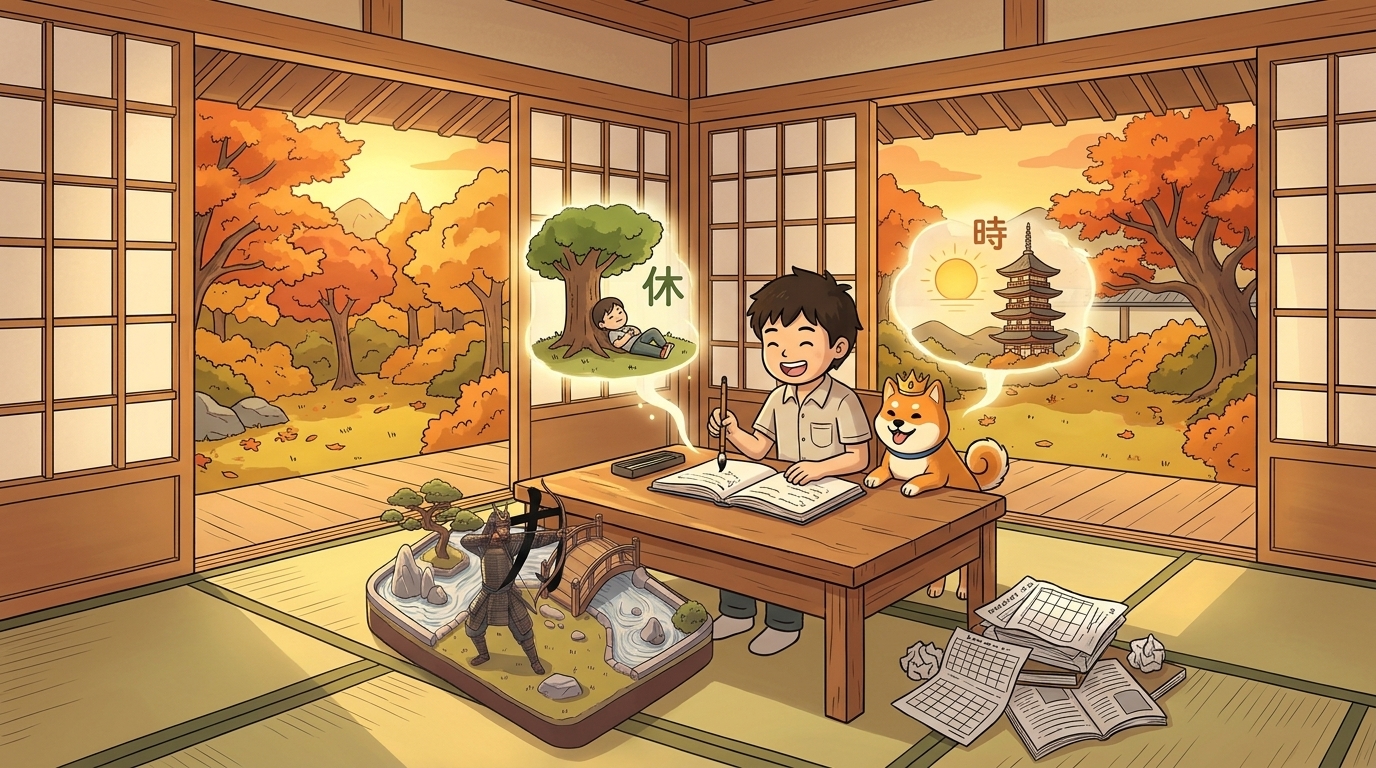
Instead of treating a 12-stroke kanji like 時 (Time) or 休 (Rest) as a tangle of random lines, effective kanji learners break every character down into its recurring building blocks — called radicals or components:
- 休 (Rest) = 亻 (Person) leaning against a 木 (Tree) to take a rest.
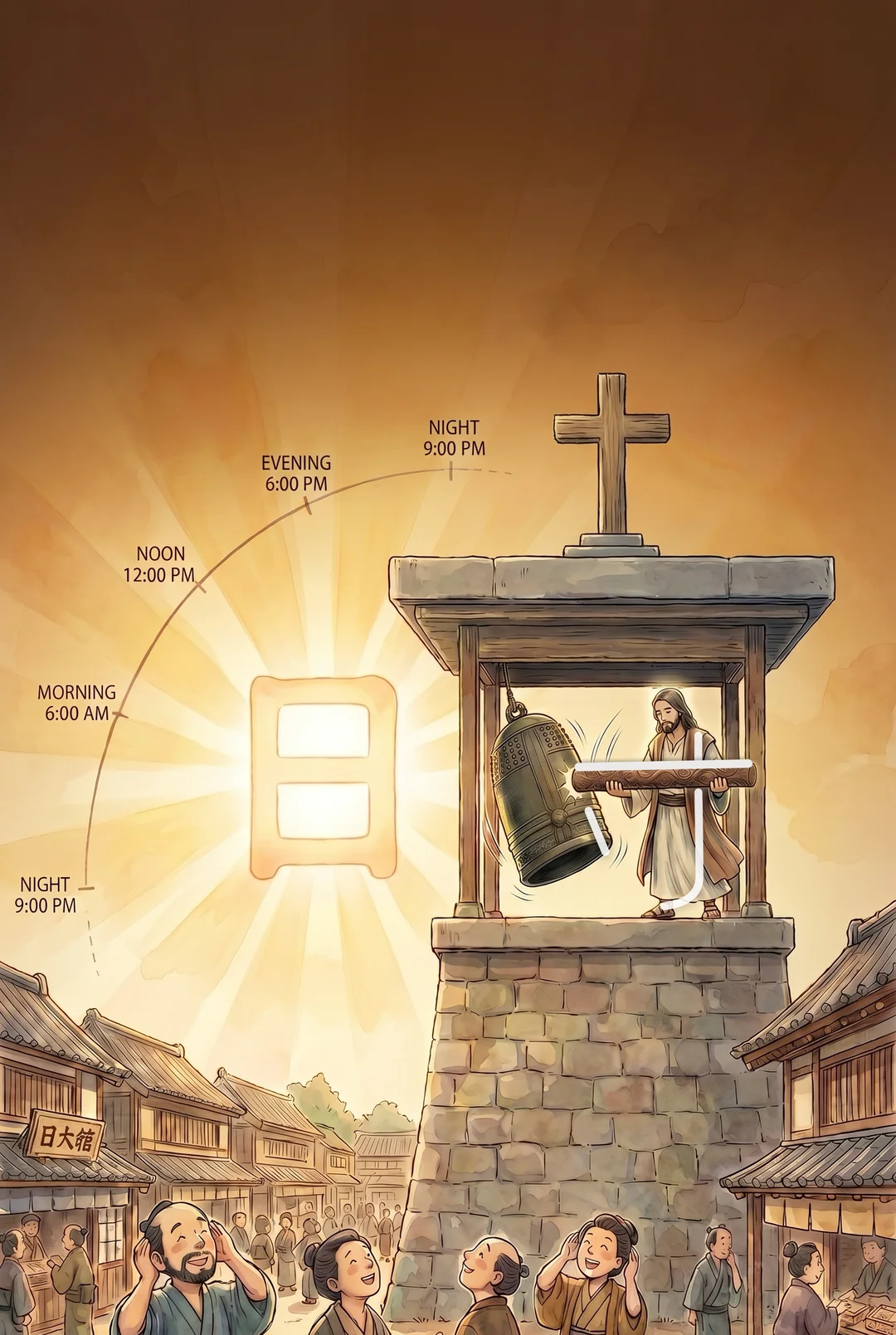
- 時 (Time) = 日 (Sun) rising over a 寺 (Temple) where monks track the hours of the day.
Look at how Shibashi brings these exact characters to life on actual illustrated flashcards — embedding both the English meaning AND the Japanese reading directly into the artwork:

3. Why Combining the Reading + Visual in ONE Scene Changes Everything
First-generation mnemonic apps popularized text stories, but they left a massive flaw: they wrote one text paragraph for the English meaning, and then forced you to read a second, completely unrelated text paragraph for the Japanese reading.
When you have to juggle two separate paragraphs of English prose for every single character, your brain suffers from mnemonic interference — you remember the story about the meaning, blank on the reading story, or mix up three different text stories during a review session.
Shibashi solves this by fusing everything into a single visual frame:
- The Kanji's Strokes & Radicals are drawn directly into the illustration so your eyes trace the exact shape of the character.
- The English Meaning is the central action of the scene (highlighted in bold orange).
- The Primary Japanese Reading is anchored as a memorable sound cue right inside the same sentence (highlighted in clickable blue audio).
4. Multiplying Your Speed with Visual Radical Families
Once you know a single visual anchor like 青 (Blue / Pure), you shouldn't wait six months to see its sibling characters. In Shibashi, kanjis are grouped into Visual Radical Families so you conquer 4 to 5 related characters at once:
- Add 氵 (Water) to 青 → 清 (Pure / Clean water)
- Add 日 (Sun) to 青 → 晴 (Clear Weather)
- Add 米 (Rice) to 青 → 精 (Spirit / Refined energy)
- Add 争 (Contend) to 青 → 静 (Quiet / Still)
By studying these families together with illustrated flashcards and real compound vocabulary words, your brain builds a high-resolution visual network instead of fragile, isolated memories.
Common Questions Answered
What is the fastest way to learn Japanese kanji?
Cognitive psychology shows that combining radical decomposition with illustrated visual mnemonics (the Picture Superiority Effect) is up to 10x faster than rote writing. Instead of memorizing 12 random strokes, you remember 1 vivid visual story that encodes both the meaning and the Japanese reading.
Why do visual mnemonics work better than text mnemonics for kanji?
The human brain processes visual scenes 60,000 times faster than written paragraphs. When an app gives you two paragraphs of text to read for every kanji, you end up memorizing English prose instead of the character. A custom illustration anchors the mnemonic directly onto the strokes of the kanji.