

On'yomi vs. Kun'yomi Explained: How to Instantly Know Which Kanji Reading to Use
The #1 reason beginners quit kanji isn't the stroke count — it's discovering that a single character has multiple pronunciations. Here is the simple rule that tells you which reading to use 90% of the time.
When you learn the English letter "A", there are only a handful of ways to pronounce it. So when beginners open a Japanese dictionary and see that a single kanji like 生 or 行 has multiple On'yomi (音読み) and Kun'yomi (訓読み) readings, panic sets in. Fortunately, a simple historical rule explains why both exist — and tells you which one to use 90% of the time.
1. Why Does Every Kanji Have Two Types of Readings?
Before the 5th century AD, Japan had a rich spoken language, but no writing system. When Japanese scholars imported Chinese characters (Kanji), they did two things simultaneously:
- Kun'yomi (訓読み — Native Japanese Reading): They attached the character for water (水) to their existing native Japanese word for water: みず (mizu).
- On'yomi (音読み — Sino-Japanese Reading): They also borrowed the original Chinese pronunciation of the character for use in compound scholarly and technical words: スイ (sui).
In fact, English does the exact same thing! Think of the symbol "Water / Aqua": when standing alone in everyday speech, we say "water" (like Kun'yomi みず). When combined into compound words like aquarium or aquatic, we use the Latin root "aqua-" (like On'yomi スイ in 水曜日 suiyōbi or 水泳 suiei).
2. The 80/20 Rule: How to Know When to Use On'yomi vs. Kun'yomi
| Pattern You See on the Page | Which Reading to Use | Real Examples |
|---|---|---|
| 1. Two or More Kanji Stuck Together (Jukugo Compound) | On'yomi (音読み) ~85% of the time | 電車 (でんしゃ densha), 先生 (せんせい sensei), 時間 (じかん jikan) |
| 2. Single Kanji Standing Alone (Noun) | Kun'yomi (訓読み) | 水 (みず mizu), 山 (やま yama), 車 (くるま kuruma) |
| 3. Kanji + Trailing Hiragana (Okurigana Verb/Adjective) | Kun'yomi (訓読み) | 食べる (たべる taberu), 新しい (あたらしい atarashii) |
3. Stop Memorizing Raw Reading Lists — Anchor Readings Visually
The worst mistake you can make is trying to recite スイ, みず as an abstract chant. Instead, Shibashi highlights the primary accepted reading in bold on the card header and weaves a phonetic sound cue directly into the illustrated story:

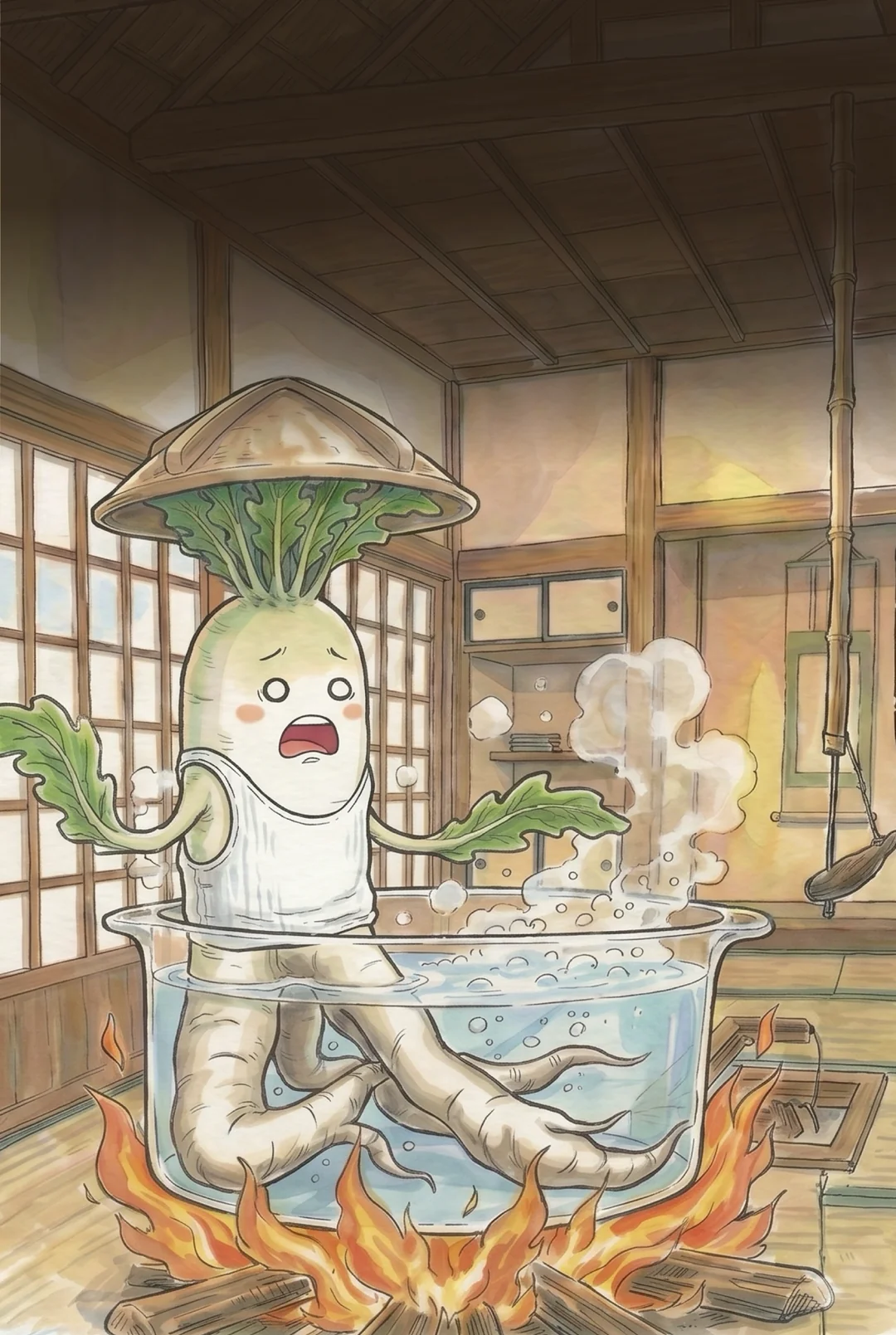
Once you lock in that primary reading via the visual story, Shibashi immediately shows you the high-frequency vocabulary words that use the character — so you absorb both On'yomi compounds and Kun'yomi standalone words naturally in context.
Common Questions Answered
What is the difference between On'yomi and Kun'yomi?
On'yomi (音読み) is the Sino-Japanese reading borrowed from historical Chinese pronunciation, most commonly used when two or more kanji combine into a compound word (jukugo). Kun'yomi (訓読み) is the native Japanese pronunciation, most commonly used when a kanji stands alone as a noun or has trailing hiragana (okurigana) attached to form a verb or adjective.
Should I memorize every On'yomi and Kun'yomi reading for a kanji?
No! Memorizing raw lists of 5 or 6 readings in isolation leads to instant confusion. Instead, anchor the primary accepted reading inside a visual mnemonic, and learn the remaining readings naturally through high-frequency compound vocabulary words.