用 (Use / Errand) vs. 同 (Same) vs. 周 (Lap / Week 週): Open-Bottom Box Kanji Compared
All three of these shapes start with a tall 3-sided frame that is OPEN at the bottom. Check whether the center vertical pillar slices through the bars (用) or stops above a Mouth box (同 / 週)!
On Japanese signs, you see 用 (yō — Use / For...) constantly: 子供用 (kodomoyō — for children), 女性用 (joseiyō — for women), and 非常用 (hijōyō — for emergencies)!
Quick Comparison: 用 (Use, Utilize) vs. 同 (Same) vs. 週 (Week) vs. 通 (Pass Through)
Compare 用, 同, 週, and 通 in the table below:
| Kanji & Meaning | Primary Readings (Bold = Primary) | Shibashi Visual Mnemonic Hook | Common Compound Word |
|---|---|---|---|
| 用 — Use, Utilize | On: よう Kun: もち |
Open-bottom frame with a center vertical line slicing through two horizontal bars = USE / ERRAND / FOR (tsukau / yō). | 用 (よう) — use |
| 同 — Same | On: どう Kun: おな |
Open-bottom frame with 一 (One bar) over 口 (Mouth box) and NO center vertical line = SAME (onaji / dō). | 同じ (おなじ) — same |
| 週 — Week | On: しゅう Kun: — |
辶 (Road) + 周 ( 土 Earth over 口 Mouth inside an open frame) = WEEK (shū). | 毎週 (まいしゅう) — every week |
| 通 — Pass Through | On: つう Kun: とお, かよ |
辶 (Road) + マ (tunnel roof) over 用 (Use) = PASS THROUGH / COMMUTE (tōru / tsū). | 通る (とおる) — to go through |
Side-by-Side Illustrated Kanji Flashcards (Tap Readings for Audio)
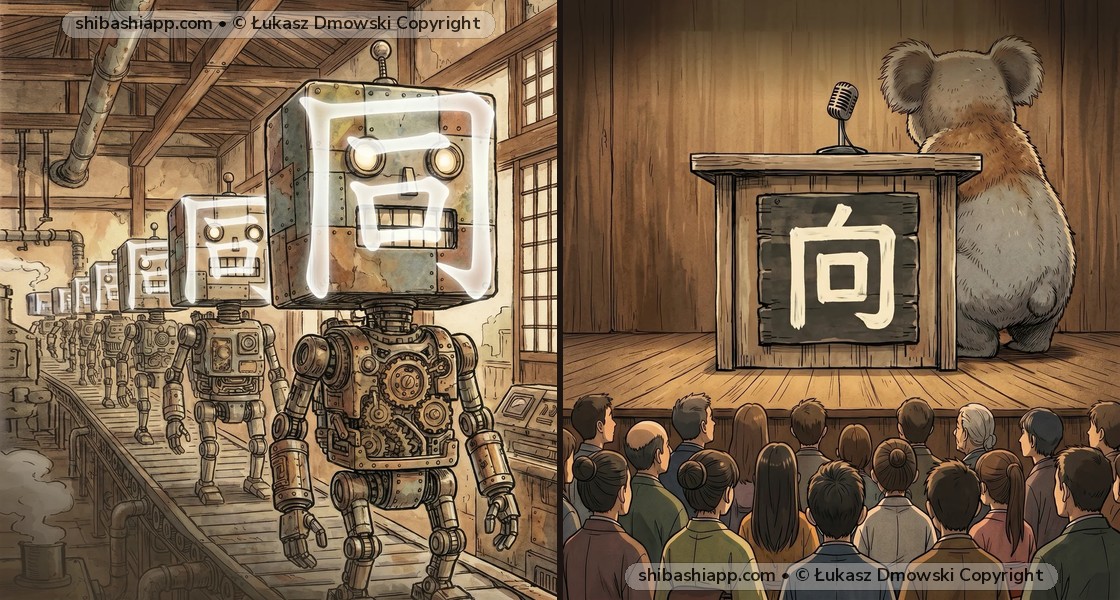
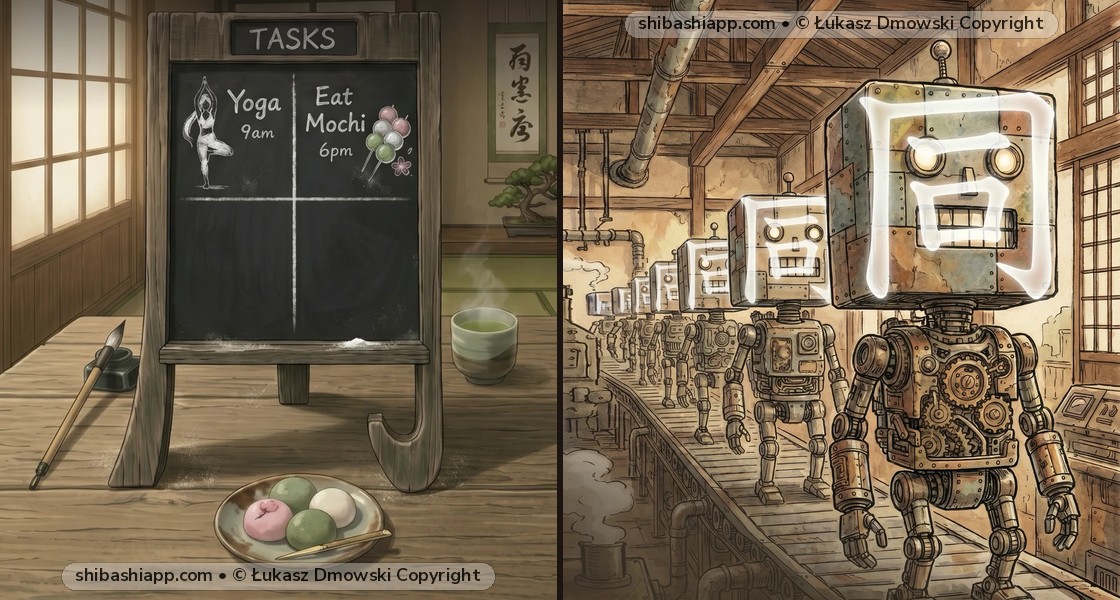
Compare the custom Shibashi artwork for 用 (Use, Utilize) and 同 (Same) below. Notice how each illustration embeds both the English meaning and the primary Japanese reading directly into the scene, and tap any reading to hear native pronunciation:


Step-by-Step Visual Breakdown & Radical Rules
Notice how 用 also sits right inside 通 (Pass through):
1. 用 (Use, Utilize) — Mnemonic Story & Readings
On'yomi: よう | Kun'yomi: もち
Shibashi Visual Story: “Japanese really love to use their task boards. Plan for today: yoga (よう) and mochi (もち).” Key visual distinction: Open-bottom frame with a center vertical line slicing through two horizontal bars = USE / ERRAND / FOR (tsukau / yō).
- 用 (よう): use
- 用意 (ようい): preparation
- 用いる (もちいる): to use, to make use of
2. 同 (Same) — Mnemonic Story & Readings
On'yomi: どう | Kun'yomi: おな
Shibashi Visual Story: “Robots on a (おな) production line are all the same, but still cost a lot of dough (どう).” Key visual distinction: Open-bottom frame with 一 (One bar) over 口 (Mouth box) and NO center vertical line = SAME (onaji / dō).
- 同じ (おなじ): same
- 同時 (どうじ): simultaneous(ly), concurrent, same time, synchronous
- 同氏 (どうし): the said person, he, she
3. 週 (Week) — Mnemonic Story & Readings
On'yomi: しゅう | Kun'yomi: —
Shibashi Visual Story: “At the end of each week, grandpa puts on his best shoes (しゅう) and rides to church.” Key visual distinction: 辶 (Road) + 周 ( 土 Earth over 口 Mouth inside an open frame) = WEEK (shū).
- 毎週 (まいしゅう): every week
- 来週 (らいしゅう): next week
- 先週 (せんしゅう): last week
4. 通 (Pass Through) — Mnemonic Story & Readings
On'yomi: つう | Kun'yomi: とお, かよ
Shibashi Visual Story: “The boy is just passing through, totally (とお) unaware of the tsunami (つう) and a coyote (かよ) in the background...” Key visual distinction: 辶 (Road) + マ (tunnel roof) over 用 (Use) = PASS THROUGH / COMMUTE (tōru / tsū).
Essential Japanese Vocabulary Words Using 用 / 同 / 週 / 通
Once you can recognize 用 (Use, Utilize) and 同 (Same) and 週 (Week) individually, lock them into your active reading vocabulary with these high-frequency Japanese words from the Shibashi app:
| Japanese Word | Hiragana Reading | English Meaning | Level |
|---|---|---|---|
| 用 | よう | use | JLPT |
| 用意 | ようい | preparation | JLPT |
| 用いる | もちいる | to use, to make use of | JLPT |
| 同じ | おなじ | same | JLPT |
| 同時 | どうじ | simultaneous(ly), concurrent, same time, synchronous | JLPT |
| 同氏 | どうし | the said person, he, she | JLPT |
| 毎週 | まいしゅう | every week | JLPT |
| 来週 | らいしゅう | next week | JLPT |
5-Second Memory Summary: How to Never Mix Up 用 & 同 & 週 Again
Grid of 3 vertical lines x 2 horizontal bars = 用 (Use / Task — 用事 yōji 'errand', 用意 yōi 'preparation'). Put a マ cap and 辶 (Road) on 用 to get 通 (Pass through / Commute). Replace the bottom leg with a closed 口 (Mouth) to get 週 (Week)!