How 1 Kanji Means Music, Fun & Comfort: 楽 (Tanoshii / Raku), 音楽 (Ongaku), 歌 (Song) & 曲 (Melody)
There is an old Japanese saying that 'Medicine (薬) is just Music/Comfort (楽) topped with Herbs (艹).' Here is why 楽, 音, 歌, and 曲 are four of the most joyful characters in Japanese.
Originally, 楽 was the drawing of musical bells and drums mounted on a wooden stand (木). Because music brought joy and relaxation, the character took on three closely linked meanings: Music (ガク gaku), Fun (たのしい tanoshii), and Comfort/Ease (ラク raku)!
Quick Comparison: 楽 (Comfort, Pleasure) vs. 音 (Sound) vs. 歌 (Song) vs. 曲 (Music)
Compare 楽, 音, 歌, and 曲 in the table below:
| Kanji & Meaning | Primary Readings (Bold = Primary) | Shibashi Visual Mnemonic Hook | Common Compound Word |
|---|---|---|---|
| 楽 — Comfort, Pleasure | On: らく, がく Kun: たの |
A white drum/bell (白) flanked by silk tassels on a wooden stand (木) = MUSIC / FUN / COMFORT (tanoshii / raku / gaku). | 音楽 (おんがく) — music |
| 音 — Sound | On: おん Kun: おと, ね |
立 (Stand) over 日 = SOUND (oto / on, combines with 楽 for 音楽 ongaku 'Music'). | 音楽 (おんがく) — music |
| 歌 — Song | On: か Kun: うた |
哥 (Two stacked singing mouths 可+可) + 欠 (yawning open mouth) = SONG / SING (uta / utau / ka). | 歌 (うた) — song |
| 曲 — Music | On: きょく Kun: ま |
A grid music sheet with two tall vertical stems poking through the top = MELODY / TUNE / BEND (kyoku / magaru). | 曲がる (まがる) — to bend, to curve, to war... |
Side-by-Side Illustrated Kanji Flashcards (Tap Readings for Audio)
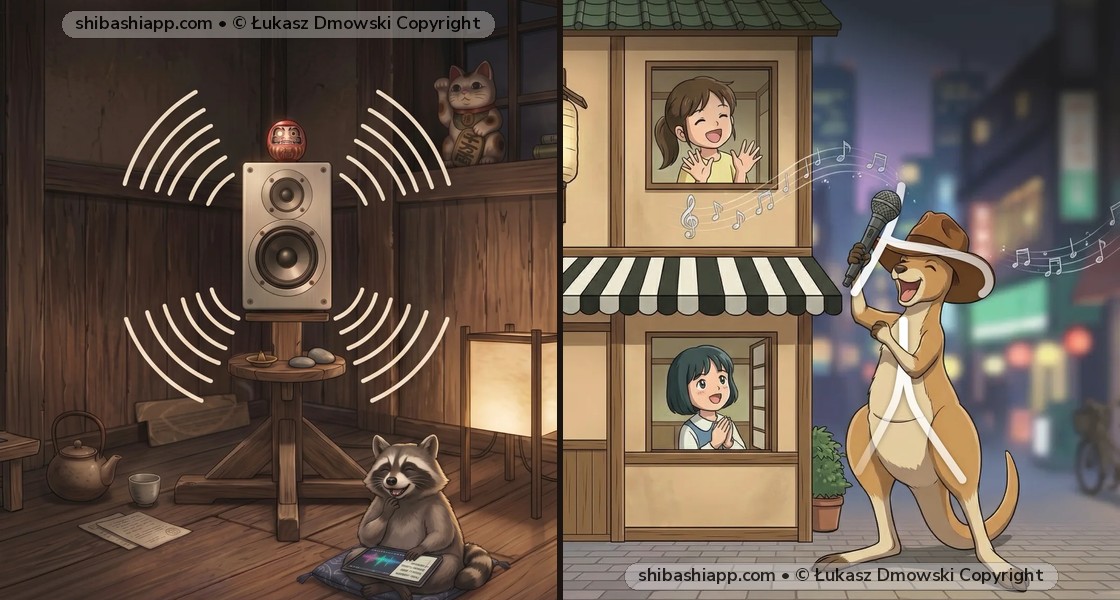
Compare the custom Shibashi artwork for 楽 (Comfort, Pleasure) and 歌 (Song) below. Notice how each illustration embeds both the English meaning and the primary Japanese reading directly into the scene, and tap any reading to hear native pronunciation:


Step-by-Step Visual Breakdown & Radical Rules
See how these four kanjis cover every musical word in Japanese — plus how adding 艹 (Herbs) to 楽 makes 薬 (Medicine — kusuri):
1. 楽 (Comfort, Pleasure) — Mnemonic Story & Readings
On'yomi: らく, がく | Kun'yomi: たの
Shibashi Visual Story: “A raccoon (らく) enjoys the simple pleasure of mega cool (がく) music, played from his tablet notebook (たの)...” Key visual distinction: A white drum/bell (白) flanked by silk tassels on a wooden stand (木) = MUSIC / FUN / COMFORT (tanoshii / raku / gaku).
- 音楽 (おんがく): music
- 楽しい (たのしい): enjoyable
- 楽しみ (たのしみ): joy
2. 音 (Sound) — Mnemonic Story & Readings
On'yomi: おん | Kun'yomi: おと, ね
Shibashi Visual Story: “Mic on (おん), the boy is doing a sound check for his talk about his autobiography (おと) Never say Never (ね)...” Key visual distinction: 立 (Stand) over 日 = SOUND (oto / on, combines with 楽 for 音楽 ongaku 'Music').
3. 歌 (Song) — Mnemonic Story & Readings
On'yomi: か | Kun'yomi: うた
Shibashi Visual Story: “Uber talented (うた) kangaroo (か) performing a song for the girls.” Key visual distinction: 哥 (Two stacked singing mouths 可+可) + 欠 (yawning open mouth) = SONG / SING (uta / utau / ka).
4. 曲 (Music) — Mnemonic Story & Readings
On'yomi: きょく | Kun'yomi: ま
Shibashi Visual Story: “Always nice to visit ma (ま), eat her signature Kyoto cookies (きょく), and browse through her music collection...” Key visual distinction: A grid music sheet with two tall vertical stems poking through the top = MELODY / TUNE / BEND (kyoku / magaru).
- 曲がる (まがる): to bend, to curve, to warp, to wind, to twist
Essential Japanese Vocabulary Words Using 楽 / 音 / 歌 / 曲
Once you can recognize 楽 (Comfort, Pleasure) and 音 (Sound) and 歌 (Song) individually, lock them into your active reading vocabulary with these high-frequency Japanese words from the Shibashi app:
| Japanese Word | Hiragana Reading | English Meaning | Level |
|---|---|---|---|
| 音楽 | おんがく | music | JLPT |
| 楽しい | たのしい | enjoyable | JLPT |
| 楽しみ | たのしみ | joy | JLPT |
| 発音 | はつおん | pronunciation | JLPT |
| 音 | おと | sound, note | JLPT |
| 歌 | うた | song | JLPT |
| 歌う | うたう | to sing | JLPT |
| 歌手 | かしゅ | singer | JLPT |
5-Second Memory Summary: How to Never Mix Up 楽 & 音 & 歌 Again
音 (Sound) + 楽 (Drums on wood) = 音楽 (ongaku — Music). Standalone with -shii, 楽しい (tanoshii) is Fun, and 楽 (raku) is Easy/Comfortable. Meanwhile, 歌 (uta) is a sung vocal Song, and 曲 (kyoku) is a musical Track / Melody!